

تفاصيل أساسية
طريقة الشحن:快递, 空运, 陆运, 海运
وصف المنتج
Parameter Category | Specific Information |
|---|---|
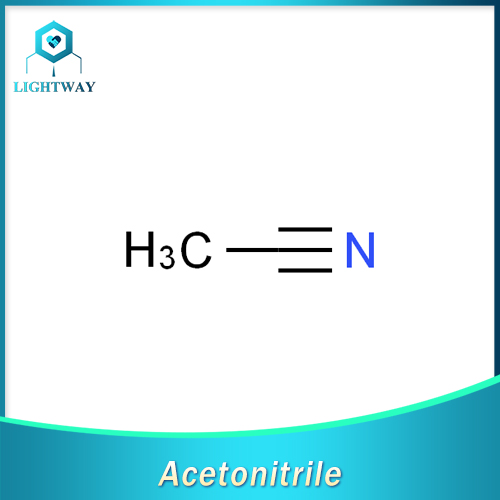
Chemical Identity | IUPAC Name: Acetonitrile
Common Synonyms: Methyl cyanide, Cyanomethane
Chemical Formula: $\ce{C2H3N}$
CAS No.: 75-05-8
Molecular Weight: 41.05 g/mol |
Physical Properties | Appearance: Colorless, transparent liquid
Odor: Sharp, characteristic pungent odor
Density (25°C): 0.787 g/cm³
Melting Point: -46°C
Boiling Point: 82°C
Flash Point (Closed Cup): 2°C
Autoignition Temperature: 524°C
Viscosity (20°C): 0.35 mm²/s
Solubility: Fully miscible with water; compatible with methanol, acetone, ether, carbon tetrachloride and most organic solvents |
Chemical Characteristics | Solvent Type: Polar aprotic solvent with strong dissolving capacity
Typical Reactions: Hydrolysis (catalyzed by acid/base) to form acetic acid and ammonia; catalytic hydrogenation to primary amines
Decomposition Risk: Releases toxic $\ce{HCN}$ (hydrogen cyanide) and nitrogen oxides when heated or burned
Compatibility Risk: Violent reaction occurs with strong oxidants |
Main Production Methods | 1. By-product recovery from propylene nitrile production process
2. Ammoxidation of acetic acid and acetylene
3. Dehydration of acetamide |
Key Applications | Analytical Field: Mobile phase for HPLC (High Performance Liquid Chromatography); solvent for NMR (Nuclear Magnetic Resonance) spectroscopy
Industrial Field: Electrolyte additive for lithium-ion batteries; cleaning agent for semiconductor components
Fine Chemicals: Intermediate for pharmaceuticals (e.g., synthetic insulin, sulfonamide drugs) and pesticides (e.g., pyrethroid insecticides) |
Safety & Hazards | Toxicity Class: Moderately toxic
Exposure Routes: Inhalation of vapor, skin absorption, eye/skin direct contact
Health Hazards: Vapor irritates nasal cavity and throat; high-concentration exposure causes nausea, vomiting, dizziness and respiratory distress
Explosion Risk: Vapor mixes with air to form explosive mixtures; flammable liquid |


