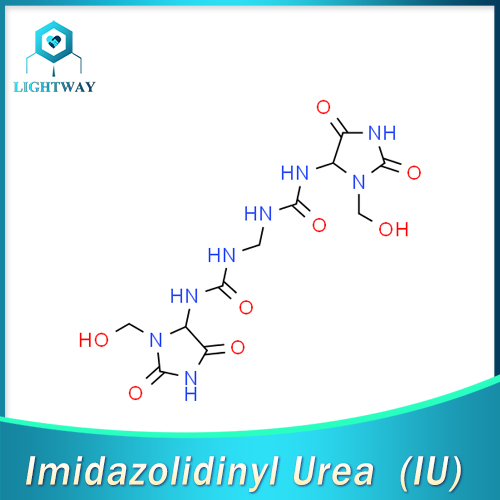


Необходимые детали
Доставка:快递, 空运, 陆运, 海运
Введение в продукт
| Parameter Category | Parameter Name | English Value/Specification |
|---|---|---|
| Basic Identification | Chemical Name | 1-(Hydroxymethyl)-5,5-dimethylimidazolidine-2,4-dione polymer with formaldehyde and urea; Imidazolidinyl urea |
| Abbreviation/INCI Name | IU; Imidazolidinyl Urea; Germall 115® | |
| CAS Registry Number | 39236-46-9 | |
| EINECS/EC Number | 254-372-6 | |
| Molecular Formula | C₁₁H₁₆N₈O₈ (representative polymer formula; core monomer: C₆H₁₀N₂O₃) | |
| Molecular Weight | 380.29 g/mol (polymer average; monomer: 158.16 g/mol) | |
| Chemical Class | Imidazolidinedione-derived formaldehyde-releasing preservative; cosmetic antimicrobial agent | |
| Physicochemical Properties | Appearance | White to off-white crystalline powder; odorless or with a faint formaldehyde-like odor (trace) |
| Melting Point | 132–138 °C (decomposes above melting point, releasing free formaldehyde) | |
| Boiling Point | Decomposes prior to reaching boiling temperature (no defined boiling point) | |
| Density (20 °C) | 1.45–1.50 g/cm³ (estimated, crystalline form) | |
| Water Solubility (25 °C) | Soluble (~30 g/100 mL, lower than diazolidinyl urea); forms clear aqueous solutions at use concentrations | |
| Organic Solvent Solubility | Slightly soluble in ethanol, propylene glycol; insoluble in non-polar solvents (hexane, chloroform, mineral oil) | |
| pH Value (5% Aqueous Solution) | 6.0–7.5 (neutral to weakly alkaline, compatible with most cosmetic formulations) | |
| Stability | Stable at pH 4.0–9.0 (optimal range for cosmetics); degrades at high temperature (>110°C) or strong acid/alkali (accelerated formaldehyde release); hygroscopic under humid conditions | |
| Biological Activity | Antimicrobial Spectrum | Broad-spectrum (effective against Gram-positive bacteria, Gram-negative bacteria, and yeasts; limited activity against molds at standard concentrations) |
| Mechanism of Action | Gradually releases free formaldehyde (HCHO) in aqueous systems, which denatures microbial cellular proteins and disrupts metabolic pathways | |
| Minimum Inhibitory Concentration (MIC) | Staphylococcus aureus: 20–40 ppm; Escherichia coli: 40–60 ppm; Candida albicans: 80–120 ppm (at neutral pH) | |
| Effective Concentration Range | 0.1–0.5% (cosmetic/personal care products; rinse-off vs leave-on); 0.3–1.0% (industrial formulations like aqueous adhesives) |


